Updates

We seek to keep you literally "updated" on movement in terms of truth and justice in the Middle East in general with a particular eye on Palestine. The links below will take you to various articles and websites that offer the perspective of leaders in the religious, NGO, and human rights communities. Additionally, Al-Bushra, ever vigilant, provides links to regular reporting as well as opinion pieces by journalists. The dates given here indicate when the link was posted; the most recent posting is at the top. Check the article itself for the date the information was released by the source.

Sunday, February 16, 2014

Gush Shalom: Israeli Supreme Court to deliberate Sunday on "Boycott Law"

A special nine-judge panel of the Israeli Supreme Court, headed by Supreme Court President Asher Gronis, will deliberate the constitutionality of the "Boycott Law " on Sunday , February 16, at 9:00  am. Israel’s Supreme Court hears routine appeals by a three-judge panel, wider panels being reserved to cases which involve substantial constitutional issues.

Former Knesset Member Uri Avnery and the Gush Shalom Movement have filed an appeal to the Supreme Court in July 2011, immediately after the Knesset  enacted the "Boycott Law ". Voted into law at the culmination of a heated debate, this piece of legislation makes anyone calling for a boycott of Israel liable to heavy torts and fines, and calling for a boycott of settlements in the Occupied Territories was defined as “a form of boycotting Israel”.  The Gush Shalom appeal was lodged via attorneys Gaby Lasky and Neri Ramati. Later, other appellants joined in, including ACRI (Civil Rights Assoc,), Adalah , MK Ahmed Tibi , the Coalition of Women for Peace, Movement for Reform & Progressive Judaism, the Arab Monitoring Committee and the group of citizens led by Adv. Adi Barkai.  

The State Attorney’ office, which asked the court to reject the appeals, nevertheless admitted in a document  presented last year to the court that the law adopted the Knesset “posed some constitutional problems". ( In fact, before the legislation passed its final vote, the Knesset’s own legal advisor asked the Members who initiated this bill to drop it – but in vain.)  

Gush Shalom movement , which had called for a boycott of settlement products since its inception, is directly targeted by this law. For the past three years. It has conducted activities under the overhanging threat of heavy lawsuits. In its appeal, Gush Shalom assets that "The Boycott Law is unconstitutional and anti-democratic, as it violates freedom of expression, the right to equality and other fundamental rights of the citizens of Israel",  that these rights are violated in a disproportionate way, and the launching a boycott is a legitimate part of democratic discourse, whose use should not be limited.

' “The boycott of the settlements and their products is not simply an issue of the foreign relations of the State of Israel and its deteriorating standing in the international community . This is also and especially an internal Israeli issue, touching directly on the future of Israel and on the debate which is cutting Israeli society down the middle for the past forty seven years " says former Knesset Member Uri Avnery." A major part of the Israeli public is completely opposed to the settlement project, regarding it as a moral stain and a political disaster  which perpetuates the oppression of the Palestinians and blocks  Israeli citizens from achieving peace with their neighbors. It is the full right of those who oppose the settlements to express their strong objection by any democratic means, including and especially a boycott campaign.

It is the right of concerned citizens to refrain from funding with their shopping  money the settlements to which they are strongly opposed. Just as religious citizens are entitled to have a 'watchdog' charged with alerting them that certain foods are not kosher under the criteria of Jewish religious dietary laws, so are peace seekers entitled to have their own watchdog alerting them that certain products originate at a settlement in Occupied Territory , even when manufacturers and shippers try obscure and conceal from consumers the origin of the product. Gush Shalom has acted as such a watchdog for more than ten years. We published lists of products originating in the settlements and our activists distributed them at public events and at the entrances to supermarkets, until the initiators of the ‘Boycott Law ' set out to gag us..

' The Boycott Law  created a situation of clear and blatant discrimination. In  the State of Israel it is allowed to publish the names of restaurants and shops  selling non-kosher products and call upon the public not to buy there. Not only is it allowed, but the boycott on non-kosher products is funded by the Israeli taxpayer. Via the ample budgets allocated to the Chief Rabbinate and Town Rabbinates. On the other hand, anyone calling upon the public not to consume the products of the settlements is liable to legal proceedings ending towehexpected to damage claims by huge amounts with payment of huge sums in damages”.

The Gush Shalom appeal cited various historical examples of boycott campaigns which had led to changes in public consciousness and in political situations, such as the boycott instituted by American Jews against Nazi Germany in 1933 ; the boycotts which Gandhi declared against British goods during the struggle to liberate India from colonial rule, and the boycotts called by the African American community in struggling against racial segregation.

The Sunday court deliberations might culminate with an immediate ruling or with the judges opting to have further proceedings.   

Contact:
Adam Keller +972-54-2340749 ,
Adv. Gaby Lasky +972-54-4418988
Adv. Nery Ramati +972- 50-8648854

Gush Shalom (Translated from Hebrew, the name means "The Peace Bloc") is the hard core of the Israeli peace movement.

Joint Communiqué Holy See – Israel


CommuniquéSaintSiègeIsrael

COMMUNIQUE – The Bilateral Permanent Working Commission between the Holy See and the State of Israel met today, February 11, 2014, in the David Citadel Hotel, Jerusalem, at the Plenary level, to continue negotiations pursuant to the Fundamental Agreement Art. 10 paragraph 2.

The meeting was headed by Mr. Ze’ev Elkin, Deputy Minister of Foreign Affairs and by Msgr. Antoine Camilleri, Under-Secretary for the Holy See’s Relations with States..
The Plenary focused on a report that brings together outstanding issues for the Final Agreement. The parties took note of the progress achieved, in a thoughtful and constructive atmosphere, since the last Plenary of June 2013, and agreed on the next steps for future plenary session scheduled for June 2014 at the Vatican.
Delegation of the Holy See:
Msgr. Antoine Camilleri, Under-Secretary for Relations  of the Holy See with States
H.E. Arch. Antonio Franco, Apostolic Nuncio, Co-Chairman of the Working Level of the Bilateral Permanent Working Commission
H.E. Arch. Giuseppe Lazzarotto, Apostolic Nuncio in Israel
H.E. Bishop Giacinto-Boulos Marcuzzo, Patriarchal Vicar for Israel
Msgr. Maurizio Malvestiti, Under-Secretary of the Congregation for the Oriental Churches
Msgr. Alberto Ortega Martín, Official of the Secretariat of State
Msgr. Matteo De Mori, Counselor of the Apostolic Nunciature
Mr. Henry Amoroso, Principal Legal Adviser
Mr. Samir Abu Nassar, C.P.A., Financial and Tax Adviser
Archimandrite Maher Abboud, Greek-Melkite Archeparchy of Akko
Fr. Ibrahim Faltas O.F.M., Custody of the Holy Land
Sr. Naomi Zimmermann F.S.E., Secretary
Delegation of the State of Israel:
Mr. Ze’ev Elkin, Deputy Minister of Foreign Affairs
Mr. Ehud Keinan, Deputy Director General, Legal Division (MFA), Co-Chairman of the Working Level of the Bilateral Permanent Working Commission
Mr. Oded Brook, Head of International Affairs Division, Ministry of Finance
Mr. Akiva Tor, Head of World Jewish Affairs and World Religions Bureau (MFA)
Mr. Rami Hatan, Director of World Religions (MFA)
Mr. Moshe Golan, Senior Deputy State’s Attorney Responsible for Civil Law Matters, Ministry of Justice
Mr. Itai Apter, Department for International Agreements, Ministry of Justice
Ms. Karin Dosoretz, General International Law Department, Legal Division (MFA)
Mr. Rony Tzuberi, Chief of Staff, Deputy Minister of Foreign Affairs
Ms. Rachel Gur, Senior Advisor, Deputy Minister of Foreign Affairs
Mr. Gershon Kedar, Deputy Foreign Minister’s Bureau
Ms Noga Katz, Media Advisor, Deputy Foreign Minister’s Bureau
Ms Tamar Abo, Law Clerk, Department for International Agreements, Ministry of Justice

Saturday, February 15, 2014

Bishop Shomali: We cannot impose democracy


ShomaliPrintempsArabe
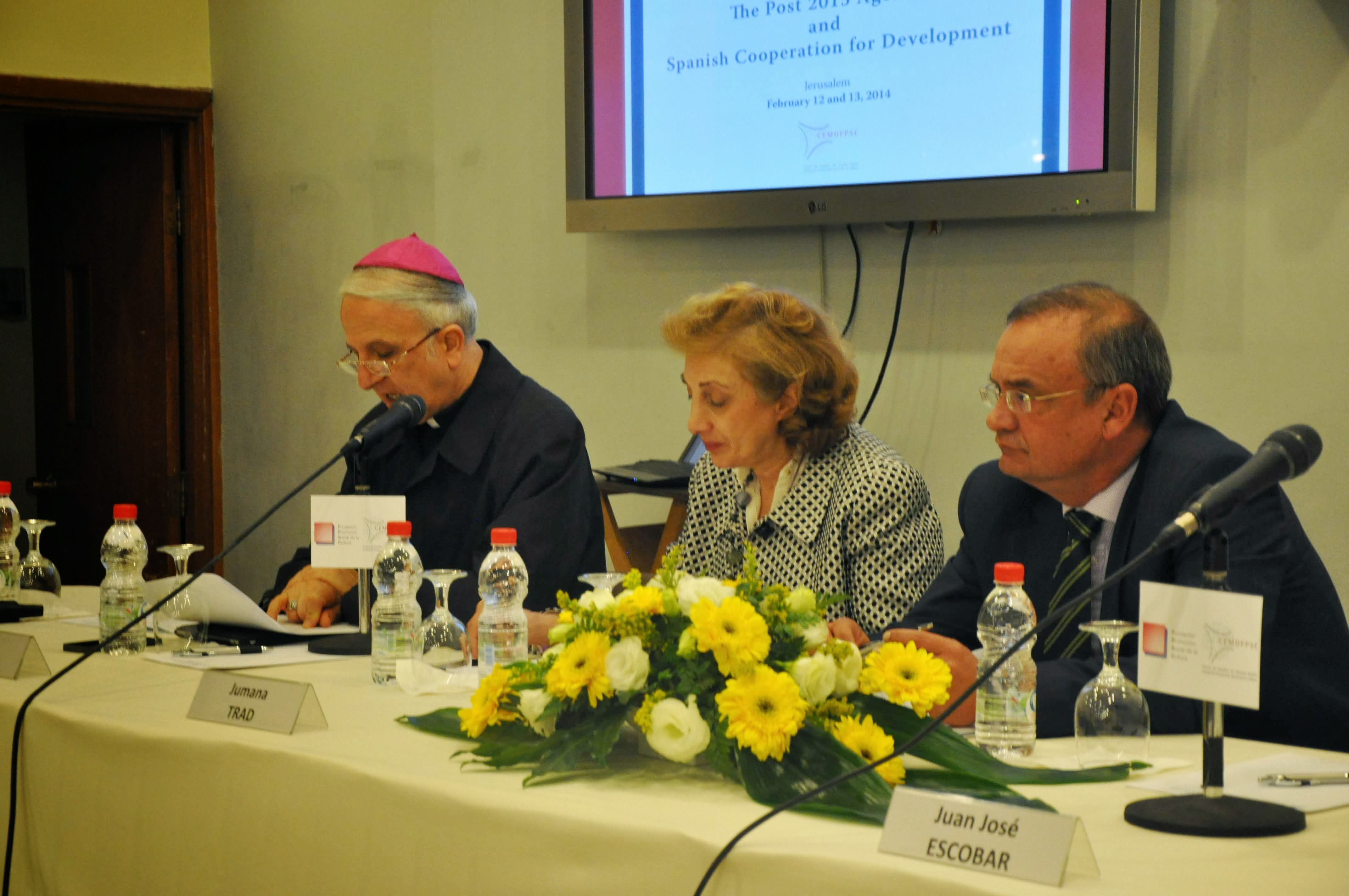
JERUSALEM – On February 12, 2014, under the patronage of Spain’s Ministry of Foreign Affairs and Cooperation, and the CEMOFPSC (Center for Middle Eastern Studies for the Social Promotion of Culture) a conference on “Arab Spring” was held in Notre Dame of Jerusalem Center, to which Bishop Shomali was invited.


A conference on the “Arab Spring” was organized at Notre Dame of Jerusalem Center this Wednesday, February 12, 2014. For the opening session, the organizers asked Bishop Shomali how he evaluates the Arab Spring.
The Patriarchal Vicar for Jerusalem spoke briefly, but with lucidity and clarity, of the relationships between the different movements of the popular unrest, and concern for democracy on the part of politicians. According to Bishop Shomali, “one cannot impose democracy. Democracy comes through education.” He also proposed a criterion to determine whether a democracy is genuine or illusory: “respect for minorities and the rights of women and children. We are speaking of more than half of society!”
As for minorities, Bishop Shomali said that few Christians in Arab countries, which have experienced these upheavals and revolutions, have actually participated in these movements, because “of fear”.
“Democracy must be prepared. Imposing democracy without preparation is like buying furniture before you build the house,” continued the auxiliary bishop of Jerusalem.
He concluded by insisting that the majority of Muslims are not fundamentalist. There are many moderate Muslims among them, and these are the ones that should be supported so that they come to power.
Mr. Juan José Escobar, Consul General of Spain in Jerusalem, was also present at this conference.
Firas Abedrabbo
DSC_0089.jpgDSC_0093.jpgDSC_0099.jpgDSC_0100.jpgDSC_0101.jpgDSC_0102.jpg
DSC_0103.jpg
DSC_0104.jpgDSC_0105.jpg
DSC_0110.jpgDSC_0111.jpgDSC_0113.jpgDSC_0114.jpg
DSC_0115.jpgDSC_0119.jpgDSC_0121.jpgDSC_0122.jpg

Friday, February 14, 2014

Tear Down This Wall

Just as the peace talks between Israel and Palestine seem to be sputtering, Israel has thrown still another obstacle in the road: their attempt to extend the separation wall through the Cremisan Valley. In the West Bank, just south of Jerusalem and next to Bethlehem, the valley is a beloved oasis, if not stronghold, of Christianity. If the wall is built, a convent of Salesian sisters who run a school with 400 students, a monastery of brothers and 58 Christian farmers would be cut off from their work, recreational lands and water sources. It is far from the international border drawn after the Six Day War in 1967.

Bishop Richard E. Pates of Des Moines, Iowa, along with bishops from Europe, Canada and South Africa, visited the agricultural valley in January. The bishops have acknowledged Israel’s need for security, but strongly condemned the seizure of land. On Jan. 28, Bishop Pates asked Secretary of State John Kerry to press Israel to “cease and desist in its efforts to unnecessarily confiscate Palestinian lands in the Occupied West Bank.” He wrote about his visit to the valley: “I was simply astounded by the injustice of it all.”

The community in the Cremisan Valley received some temporary relief on Feb. 3. In response to a citizens’ appeal, the Israeli Supreme Court issued a preliminary order to stop construction of the wall in that area. Israel has until April 10 to explain why there are no alternative routes. In October 2012, the Catholic ordinaries of the Holy Land said the planned construction of the wall “will put more pressure” on the Christians living in Bethlehem, and “more people will make the decision to leave.” It is hard to escape the conclusion that this is what the government of Israel intends.


Editors, America Magazine, the National Catholic Review

http://americamagazine.org/issue/current-comment-33

Thursday, February 13, 2014

Pope Addresses American Jewish Community; Rabbi David Rosen Comments

VATICAN CITY, February 13, 2014 (Zenit.org)

Here is the translation of the Holy Father's address to a delegation from the American Jewish Institute this morning.

* * *
Dear friends,

I welcome you here today. Your organization, which on various occasions has met with my venerable Predecessors, maintains good relations with the Holy See and with many representatives of the Catholic world. I am very grateful to you for the distinguished contribution you have made to dialogue and fraternity between Jews and Catholics, and I encourage you to continue on this path.

Next year we will commemorate the fiftieth anniversary of the Declaration of the Second Vatican Council Nostra Aetate, which today constitutes for the Church the sure point of reference for relations with our "elder brothers". From this document, our reflection on the spiritual patrimony which unites us and is the foundation of our dialogue has developed with renewed vigour. This foundation is theological, and not simply an expression of our desire for reciprocal respect and esteem. Therefore, it is important that our dialogue be always profoundly marked by the awareness of our relationship with God.

In addition to dialogue, it is also important to find ways in which Jews and Christians can cooperate in constructing a more just and fraternal world. In this regard, I call to mind in a particular way our common efforts to serve the poor, the marginalized and those who suffer. Our commitment to this service is anchored in the protection of the poor, widows, orphans, and foreigners as shown in Sacred Scripture (cf. Ex 20:20-22). It is a God given duty, one which reflects his holy will and his justice; it is a true religious obligation.

Finally, in order that our efforts may not be fruitless, it is important that we dedicate ourselves to transmitting to new generations the heritage of our mutual knowledge, esteem and friendship which has, thanks to the commitment of associations like yours, grown over these years. It is my hope therefore that the study of relations with Judaism may continue to flourish in seminaries and in centres of formation for lay Catholics, as I am similarly hopeful that a desire for an understanding of Christianity may grow among young Rabbis and the Jewish community.

Dear friends, in a few months I will have the joy of visiting Jerusalem, where – as the Psalm says – we are all born (cf. Ps 87:5) and where all peoples will one day meet (cf. Is 25:6-10). Accompany me, please, with your prayers, so that this pilgrimage may bring forth the fruits of communion, hope and peace. Shalom!

Rabbi David Rosen: Meeting With Francis Was Like Family Reunion
Notes Significant Developments in Judeo-Christian Relationships
By Junno Arocho Esteves

ROME, February 13, 2014 (Zenit.org)

Rabbi David Rosen, the American Jewish Committee's Director for the Department of Interreligious Affairs, described his meeting today with Pope Francis as feeling like a “family reunion.” The rabbi spoke on today’s audience with the Holy Father in a press conference held at Vatican Radio’s headquarters.

Also present were Jesuit Father Federico Lombardi, director of the Holy See Press Office, and Fr. Norbert J. Hoffman, secretary of the Pontifical Commission for Relations with the Jews. Twenty members of the American Jewish Committee who attended today’s audience with the Pope were at the press conference as well.

Regarding the significance of today’s meeting, Rabbi Rosen said that Judeo-Christian relations have continued to thrive since the publishing of Nostra Aetate. That Second Vatican Council document, he said, marked a turning point in the perception of Jewish people.

The rabbi remarked that although such pontiffs as John XXIII, John Paul II, and Benedict XVI had taken Judeo-Christian relations to new heights, many believed that no pope after Benedict would “understand the Jews, the significance of the Shoah, or be interested in relations with Jews.”

“There has never been a pope who has had as much intimacy, as much personal friendship, as much engagement with the Jewish community as Pope Francis,” Rabbi Rosen said.

The most important aspect of today’s meeting, he noted, was not what was said but rather what was experienced and felt in the meeting.

“That of course is the amazing power of Pope Francis, this charism that has enveloped him since he has ascended to the pontificate,” Rosen said.

“But it has a special significance in terms of the Jewish-Catholic relationship because we are not only coming to a friend but somebody who sees us as friends. And therefore, in a sense, it was a kind of family reunion. That was the feeling, it was a special family meeting.”

Despite what theological differences Jews and Catholics may share, Rosen said that this sense of seeing the Jewish people not just as the roots of Catholicism but as family has brought a unique affection and warmth that he said was “powerful”.

Shortly after the audience, Rosen said that he, alongside members of the American Jewish Committee, met with Cardinal-designate Pietro Parolin, the Vatican Secretary of State, and Cardinal Kurt Koch, president of the Pontifical Council for Promoting Christian Unity. While they discussed several theological differences between them, Rosen said that nevertheless those main theological points have been addressed.

While acknowledging that anti-Semitism is a problem that cannot be “fixed overnight”, Rosen said that the teachings of the Catholic Church affirm the validity of the Jewish community.

“Today, the official teaching of the Church is not only categorically opposed to anti-Semitism, but has defined it as a sin against God and man. The problems in terms of Jews as seen as rejected, that is not the teaching of the Catholic Church,” he said.

Before concluding his remarks, Rabbi Rosen reiterated Pope Francis’ final point in his address: the education of younger generations on the importance of Judeo-Christian relations. The relationship between the Jewish community and the Catholic Church in the United States, he noted, is one such example.

“Many here will tell you that [in the United States], not only are there close relationships with the Catholics, but probably the Catholic Church is seen as the closest friend of the Jewish community,” he said.

Regarding the Pope’s upcoming visit to the Holy Land, Rabbi Rosen said that although he would have wished the trip would be much longer, he was certain that the Holy Father “would do everything that has to be done.”

“Everybody is excited!” he said. "No matter how short, it is a guaranteed success. It will be received wonderfully and leave a greater hope for the future and that’s what we need in the Middle East.”

“Pope Francis’ visit”, he concluded, “will be an inspiration to the people of the Holy Land.”

WCC: Ecumenical Patriarch Bartholomew affirms significance of peace and dialogue


“As faith communities and religious leaders, we are obliged constantly to remind people about the obligation and responsibility to choose peace through dialogue,” said Bartholomew, Ecumenical Patriarch of Constantinople.

07 February 2014

He addressed the 17th Eurasian Economic Summit, speaking on behalf of the Ecumenical Patriarchate, a founding member of the World Council of Churches (WCC).

The summit was held 4 to 6 February in Istanbul, Turkey by the Marmara Foundation.

“Human conflict may well be inevitable in our world; but war and violence are certainly not,” said Bartholomew. “If our age will be remembered at all,” he continued, “it may be remembered for those who dedicated themselves to the cause of peace”.

Speaking about interfaith dialogue, the Ecumenical Patriarch noted that “historical conflicts between Christians and Muslims normally have their roots in politics and not in religion itself.”

“Christians and Muslims have lived together, sharing the same geographical region, in the context of the
 Byzantine and the Ottoman Empires,” he pointed out.

These historical models, Bartholomew said, reveal “possibilities in our own world, which is shaped by pluralism and globalization.”

“This is precisely why a dialogue, which acknowledges differences but also suggests ways to negotiate differences, may prove helpful to map out appropriate avenues of communication.”

“It is the only way of discovering the peace,” added the Ecumenical Patriarch.

Speech by Ecumenical Patriarch Bartholomew at the 17th Eurasian Economic Summit in Istanbul

WCC programme for inter-religious dialogue and cooperation


Wednesday, February 12, 2014

Working in a frenzy: the pope is coming


Commissions Article


(original French below; translation to English by Al-Bushra)

Jerusalem -- In a little less than five months, Pope Francis will make his first visit to the Holy Land since the beginning of his pontificate. For the Church who will receive the Supreme Pontiff, the visit is characterized by great joy but also by a significant amount of organization to welcome him. At the Latin Patriarchate of Jerusalem preparation has already begun.

There is always a lot at stake with the arrival of a pope in a country, for the local Church, for those who are believers and those who aren't, for politicians and for passers-by. Especially since it's about the arrival of a very popular pope, Pope Francis, in one of the most torn apart areas in the world. The brevity of his visit--only three days to encounter Jordan, Palestine, and Israel--makes developing his program there particularly difficult. Indeed, the "obligatory" visits associated with the duties of a pope, who is the head of a religion and a head of state, must be planned. But there are also visits more pastoral in nature written into an ongoing pontificate characterized by the Holy Father's attention to the poor, to refugees, and to Church unity.

For the visit of a pope, as for the visit of any head of state, several things must be worked out. First, there is everything which directly affects the guest--lodging, transportation, protocol. There is as well everything that affects those taking part in the gatherings; this is where logistic teams come into place. Not to be omitted are media teams that will play an active role in the movement of the pope, relaying the visit so that the whole world can live it. Finally, as head of the Church, the pope is expected to celebrate Mass, and so there are liturgical teams.

In each of these areas, a commission is responsible for working in collaboration with the Vatican and the host countries. There are a total of five commissions for Jerusalem and Bethlehem and four for Jordan.

Further intensifying preparations is the necessity for the cooperation of the Custody of the Holy Land--the guardian of all the holy sites-- and Roman Catholics, Melkites and Maronites, who recognize the authority of the pope. In the heart of at least two of these commissions is Father George Ayoub, Diocesan Chancellor, who explains in a challenging tone, "The pope isn't coming just for Roman Catholics but for all Catholics, and so everything must be organized with them."  

"This doesn't cause us any concern," stated Msgr Shomali, Patriarchal Vicar for Jerusalem, as more of a challenge. "On the contrary, we must work together and meet together so that we may all benefit from this visit."

Now that the commissions have been announced, each is able to get to work in its area to best prepare for the visit. The goal is for the pope to have as few worries as possible so that he can devote himself to his pastoral mission and give his message all the strength he wishes.

Pierre Loup de Raucourt

Branle-bas de combat, le pape arrive


Commissions Article 

JERUSALEM – Dans un peu moins de cinq mois, le pape François se rendra pour la première fois en Terre Sainte depuis le début de son pontificat. Pour l’Eglise qui reçoit le Souverain Pontife, c’est une grande joie, mais aussi une organisation importante pour l’accueillir. Au Patriarcat latin de Jérusalem, les préparatifs ont déjà commencé.

La venue d’un pape dans un pays a toujours plusieurs enjeux, pour l’Eglise locale, pour les croyants et ceux qui ne le sont pas, pour les hommes politiques et les passants. Surtout lorsqu’il s’agit de la venue d’un pape très populaire, le pape François, dans une des zones les plus déchirées au monde. La brièveté de son voyage – seulement trois jours pour rencontrer la Jordanie, la Palestine et Israël – rend l’élaboration d’un programme particulièrement difficile. Il faut en effet prévoir les visites « obligatoires » dues aux responsabilités du pape qui est chef religieux et chef d’Etat. Mais aussi les visites d’avantage pastorales qui s’inscrivent dans  la continuité du pontificat marqué par l’attention portée par le Saint Père aux plus pauvres, aux réfugiés et à l’unité de l’Eglise.

Pour la visite d’un pape, comme pour la visite de tout chef d’Etat, de nombreux points sont à prévoir. D’abord ce qui touche l’hôte directement, c’est-à-dire le logement, les transports, ou le protocole. Il y a également tout ce qui concerne l’afflux des personnes qui participent aux rassemblements : pour cela des équipes de logistique entrent en place. Il ne faut pas omettre les équipes médias qui ont une part active dans le déplacement du pape et qui relaient dans le monde entier la visite pour que tous puissent la vivre. Enfin, comme chef de l’Eglise catholique, le pape prévoit aussi de célébrer la messe, ce qui nécessite des équipes pour la liturgie.

Pour chacun de ces domaines, une commission est chargée de travailler en collaboration avec le Vatican et les gouvernements des pays visités. Il y en a cinq au total pour Jérusalem et Bethléem, et quatre pour la Jordanie.

Pour intensifier encore la préparation, il faut que se mettent d’accord la Custodie de Terre Sainte, gardien des Lieux Saints, les catholiques latins, melkites et maronites qui reconnaissent tous l’autorité du pape. Au cœur d’au moins deux commissions, le père Georges Ayoub, chancelier du diocèse, explique avec un air de défi que « le pape ne vient pas seulement pour les latins, mais pour tous les catholiques. C’est donc avec eux qu’il faut tout organiser ». « Cela ne doit pas nous inquiéter, surenchérit Mgr Shomali, vicaire patriarcal pour Jérusalem. Au contraire, nous devons travailler ensemble et nous rencontrer pour que nous puissions tous tirer profit de cette visite ».

Maintenant que la liste des commissions a été publiée, chacun peut se mettre à l’œuvre dans son domaine afin de préparer au mieux la visite. Cela a un objectif : que le pape soit le moins préoccupé possible et puisse se consacrer entièrement à sa mission pastorale en donnant à son message toute la force qu’il souhaite lui donner.

Pierre Loup de Raucourt